We won. OneJourney takes the Wildcards category at the 2026 Global Startup Pitch at Phocuswright Europe, Barcelona. Read more
Virtual card payments and AP automation for US hotels

Your margins are dropping. Your supplier payments earn you nothing.

Hotels are bringing in more revenue than ever. Profit is still shrinking. Every year your property sends out thousands of payments to vendors and gets nothing back. OneJourney's virtual cards return 1% on that spend. No setup fee. No monthly cost. Nothing changes about how your team works.

Winner, Wildcards Category, Phocuswright Europe 2026 Global Startup Pitch Visa & Mastercard rails Issued through regulated banking partners Month-to-month, cancel any time
The margin problem

Revenue is up. Profit is down.

In CBRE's survey of 2,216 hotels, gross operating profit margins fell from 35.1% in 2024 to 34.8% in 2025. EBITDA margins dropped from 23.3% to 22.8%. That happened in a year when revenue went up.

You already know what that means. More revenue is coming in with more cost attached to it. Labour costs, which CBRE puts at over half of operated department expenses, have already been cut as far as they can go.

So here's a question your ownership group has probably never thought to ask: what is your accounts payable department contributing?

34.8%
GOP margin in 2025, down from 35.1%
CBRE Trends, 2,216-hotel sample
22.8%
EBITDA margin in 2025, down from 23.3%
CBRE Trends
$9.40
Average cost to process a single invoice
Ardent Partners, 2025, cross-industry
The invisible cost centre

A hundred suppliers. Three thousand invoices. Zero dollars back.

A typical full-service US property has active accounts with over a hundred suppliers. Food distributors, laundry services, maintenance contractors, utilities, tech vendors. Each one sends invoices. Someone on your team processes them by hand, at an average cost of $9.40 each. Then the money leaves by ACH, wire, or check. That's it.

Here's a real US hotel's AP file from a single year:

Total vendor spend$1,758,411
Invoices processed2,935
Largest vendor, food distribution$501,738 · 557 invoices
Commercial laundry$197,327 · 203 invoices
Food service$103,358 · 90 invoices
Returned to the property$0

Eleven invoices every working day. All processed by hand. None of them earning anything.

From a real US hotel AP file analysed by OneJourney. Cost benchmark: Ardent Partners, 2025 (cross-industry average $9.40, falling to $2.78 for best-in-class teams).

The aha

The OTAs figured this out years ago. Using your money.

When an OTA owes your hotel for a booking, it doesn't wire the cash. It pays you with a virtual card. You process that card and absorb the acceptance cost. The OTA earns on money it already owed you.

Same rails. Same networks. Same card numbers. Just pointed in the direction that benefits them.

Nobody ever flipped it the other way.

When your hotel pays a supplier, you should be the one earning. Not the vendor's bank. Not a middleman. You.

Today: OTA → your hotel
OTA owes you for a booking pays by virtual card
The OTA earns the settlement value. You absorb the acceptance cost.
Flipped: your hotel → supplier
You owe a supplier you pay by virtual card
Same rails, pointed the other way. Now you keep the 1%.
How it works

Four steps. No project plan.

1

Fund your wallet.

Load your SwiftPay wallet with a transfer from your existing business bank account. Your account is in your hotel's legal name. Your money stays your property the whole time.

2

Pay suppliers by card instead of ACH.

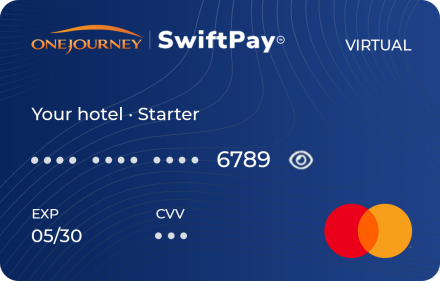
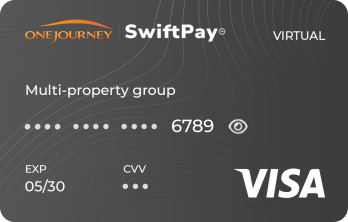
Issue a single-use virtual card tied to a specific invoice, with a 30-day expiry. Or use a reloadable card for recurring spend. Works on open-loop Visa and Mastercard, wherever cards are accepted.

3

Keep the 1%.

You earn 1% on eligible settled card spend and you keep all of it. No cap. No minimum. No monthly fee. First payout comes within 60 days of launch, then roughly every 30 days.

4

Reconciliation gets easier.

Every payment is logged with the invoice attached, syncing to QuickBooks Online or Xero. Manual matching is available from day one. Our automation trains on your invoices during setup and goes live during your pilot.

Honest note: cross-border payments and currency conversion can bring the rate below 1% at times. FX and cross-border fees are set by the networks and banks, not by us.

The IT objection

Works with everything you already have.

Your PMS and ERP stay.

No integration project. SwiftPay works from your existing AP output from day one.

Your card processing stays.

Guest payments and merchant services are not affected. This is only the pay-out side.

Your existing card programs stay.

This covers the spend your current cards can't reach.

Your bank stays.

Same accounts, same signatories.

Your approval process stays.

Whoever approves invoices today keeps doing that. Only the payment method changes.

Your suppliers stay.

They don't sign anything with us or pay us a surcharge. Card acceptance costs stay between them and their bank.

Vs. your corporate card

You have a corporate card. This is different.

Your current card program covers travel, entertainment, and small purchases. It doesn't cover the big supplier payments. There's a reason for that.

Large vendor payments live on ACH and check because they're too big for standard business card limits. Renovation cycles, annual tech contracts, food distribution accounts over six figures. SwiftPay is pre-funded, not credit-based. No credit ceiling. No application. No personal guarantee.

Corporate cardSwiftPay
Reaches ACH / wire / check spendNoYes
Credit limit constraintYesNone, pre-funded
Personal guaranteeOftenNever
Single-use card per invoiceRarelyStandard
Platform costVaries$0
CommitmentAnnualMonth-to-month
Supplier acceptance, handled honestly

“Our vendors will never go for this.”

That's what most hotel finance teams say first. But it's not as true as it sounds. In a Mastercard survey, 93% of B2B suppliers said digitizing their payments is a top priority, and two thirds said they regularly fall short of what buyers expect. When US suppliers are asked why they don't accept virtual cards, 42% say it's a processing issue, not unwillingness.

The suppliers aren't the problem. The process is.

Here's what we do. We check your actual supplier list against the card networks before you commit to anything. Our team contacts and onboards your vendors, starting with those already set up to accept cards. You don't make any calls. And if a vendor charges a surcharge that's more than the 1%, we flag it and keep them on ACH. You only move the spend where the numbers work.

This isn't a complete switch. It's a hybrid by design. Your suppliers also get paid right away instead of waiting 45 to 60 days, which most of them appreciate.

Supplier priority and buyer-expectation figures: Mastercard, 2025. Virtual card acceptance barrier: Strategic Treasurer, 2022 Virtual Card Solutions survey, cited by Mastercard.

What it's worth

What this looks like on a real P&L.

Two things determine the number: how much of your non-payroll spend can be paid by card, and how much you choose to move. Here's how it looks for a 150-room full-service property.

Annual non-payroll supplier spend$3,000,000
Share confirmed card-addressable60% · $1,800,000
Cash back at 1%$18,000 / year
Platform, setup and support cost$0
Rooms you'd sell for the same profit at $200 ADR, 10% net margin~900 room nights

Nine hundred room nights of extra profit from payments you're already making. No new bookings. No extra headcount.

Illustrative. Actual results depend on your supplier mix, card acceptance rates, and how much spend you move. A free AP analysis gives you the real number for your property.

Estimate your range in 30 seconds

Illustrative. Actual results depend on your supplier mix and card acceptance rates.

Get your free AP analysis
The offer

Send us one file. We'll tell you what it's worth.

No pitch. No trial. No commitment. Send us a vendor payment report from QuickBooks or your accounting system, and we'll run it against the card networks under NDA.

What you get back, in writing:

  • The share of your spend that cards can reach today.
  • Your top vendors ranked by acceptance.
  • What 1% is worth at three spending levels.
  • Which vendors we'd leave on ACH and why.
  • An honest answer on whether it's worth your time.

If there's no upside, we'll tell you. No rollout.

We'd rather say that in week one than sell you something that doesn't work.

If the numbers work: a one-page agreement, a bank KYB application, and a 30-day pilot on a handful of vendors. Bank review typically takes one to three weeks. Then you decide.

Not ready to send a file? Download the four-question AP diagnostic, a two-minute self-check you can run before talking to anyone.

Start my AP analysis

Property or group name · Rooms · Your role · Work email · Approximate annual non-payroll supplier spend · Accounting system

Confidential and under NDA. No obligation. Typically five business days.

Proof

Built by people who have run hotels and built card programs.

Brian Dass, Co-Founder & CEO

Thirty years in hospitality technology with two exits: Timeless Hospitality, acquired by TravelClick (Amadeus), and Open Hospitality, acquired by Pegasus (Cendyn). Over fifteen years operating luxury hotels in New York City.

John Jamieson, Co-Founder

Three decades in commercial cards and B2B payments, with leadership roles at MBNA, Bank of America, and WEX. Founder of B2B payments company PayClearly.

Hotel operators on one side. Payments veterans on the other.

"Hospitality is a cash-flow-tight business, so any opportunity to unlock additional capital from expenses we are already paying is meaningful. SwiftPay was an easy decision because it creates direct net income without operational disruption. We have now executed multiple supplier payments, and the experience has been precisely as it was described "" seamless, transparent, and easy to manage. We have full visibility into every transaction and our wallet balance at all times."

José Luis Alonso Martínez, Director, Muralto Madrid Princesa Serviced Apartments

Recognition: Winner, Wildcards Category, Phocuswright Europe 2026 Global Startup Pitch, Barcelona. Covered in Hospitality Net, PhocusWire, Hospitality Technology, Travel Daily News and Hotel Online.

Partners: DayBlink GPO · EML Payments · M Payment Services

Security and structure

Where your money sits, and who holds it.

OneJourney is not a bank and does not hold your funds. Your account is in your hotel's legal name. Your money is always your property.

Card issuing, identity verification (KYB/KYC), AML and sanctions screening, and settlement are handled by regulated banking partners under their own terms. Your application goes directly to the issuing bank over a PCI DSS secured channel. We act as a processor.

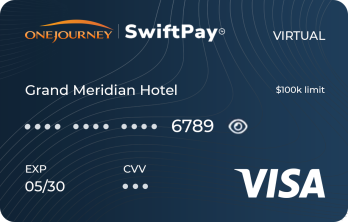
Every payment is a single-use or amount-bound virtual card on Visa and Mastercard rails, with full network chargeback protection and a permanent ledger record.

Cards are for business-to-business use only. Activation is subject to banking partner approval.

FAQ

Questions finance teams ask.

How does the hotel actually make money?

You pay suppliers with a SwiftPay card instead of a bank transfer. The payment earns interchange, and 1% of it comes back to you. It's money back on spend you're already making.

Is there a cost, or a monthly fee?

No. No setup, platform, training, support or reconciliation fee, no minimum spend and no early-termination fee. The 1% covers the platform.

So how do you make money?

From the remainder of the interchange the payment generates, paid by the networks and banks. Not by you, and not from your 1%.

What can I pay for?

It's open-loop, so anywhere cards are accepted: food and beverage suppliers, OS&E, laundry, technology vendors, marketing, OTA and agency commissions, travel and trade-show spend.

How long does onboarding take?

A short call, one secure form, and a bank review. Typically one to three weeks depending on how fast your information is verified. We're with you through every step.

What do I have to sign?

A one-page OneJourney participation agreement, plus the bank's secure KYB/KYC application.

What financials do you need?

Audited is smoothest, CPA-reviewed works well, and company-prepared statements are fine. Put forward the best you have.

Am I locked in?

No. Month-to-month, cancel any time, no penalty.

Do my suppliers have to do anything?

They don't onboard with us, don't sign anything and don't pay us a surcharge. Standard card acceptance costs stay between them and their acquiring bank.

Does this replace our accounting system or PMS?

No. We sync to QuickBooks Online and Xero. Everything else stays exactly as it is.

We already have a corporate card. Why this?

Because your corporate card can't reach the ACH, wire and check spend, which is where most of your supplier money actually goes.

Every payment your hotel makes should pay it back.

Send one supplier file. Get a confidential analysis in about five business days. Decide from there.

Questions? hotels@one-journey.com · No prep needed.